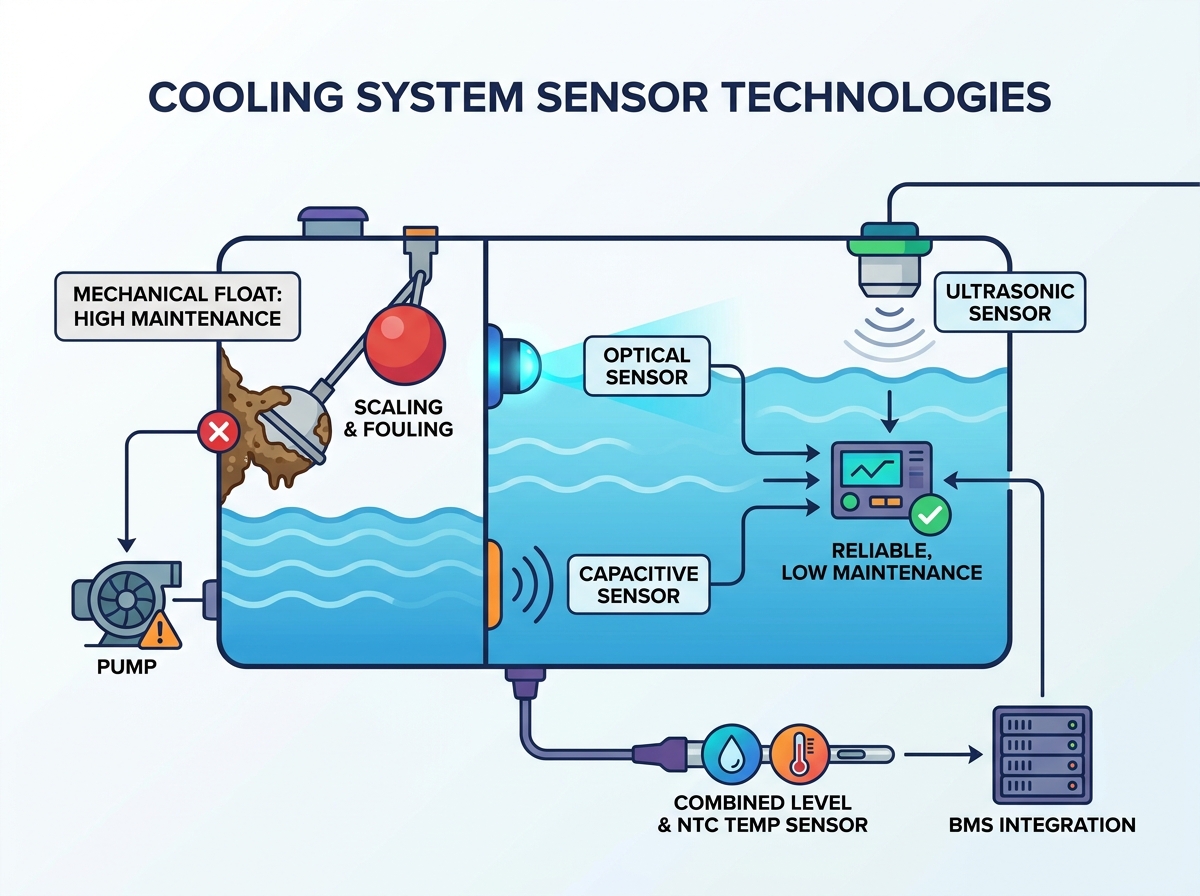
Sensor failures in cooling systems trigger disastrous operational risks. Dry runs routinely destroy expensive pumps in a matter of minutes. Overflowing basins waste thousands of gallons of water and create significant facility hazards. Unnoticed low levels often force thermal shutdowns in critical infrastructure, disrupting essential operations. Evaporative cooling setups present uniquely harsh environments for sensitive electronics. You must account for severe mineral scaling when selecting components. Constant fluid turbulence degrades measurement accuracy continuously. Biological growth and aggressive chemical dosing aggressively attack submerged materials. Relying on basic hardware often leads to catastrophic system failures during peak summer demand. We created this guide as a pragmatic, engineering-focused framework. You will learn how to evaluate and shortlist the right sensor technology efficiently. We base these decisions on strict application demands and proven long-term reliability. Our approach eliminates guesswork from the critical design phase. You can apply these principles to both small commercial units and massive industrial cooling installations.
Key Takeaways
Selecting an evaporative cooler water level sensor requires balancing upfront cost against the maintenance realities of scaling and biological fouling.
Non-contact or solid-state sensors (capacitive, optical, ultrasonic) offer higher long-term reliability than traditional mechanical float switches in harsh cooling environments.
Data center and industrial cooling tower applications demand strict adherence to material compatibility (e.g., PTFE/Stainless Steel) and specific output signals for BMS (Building Management System) integration.
Diagnosing Cooling System Environment Challenges
High mineral content creates immediate problems for cooling equipment. Hard water leaves heavy calcium deposits on submerged components. This scaling inevitably bridges electrical contacts. It also jams moving parts on basic mechanical switches. Algae growth complicates the environment even further. Biological films coat sensor surfaces quickly in warm environments. They block optical signal transmission and insulate thermal probes. We must treat these water quality issues as primary structural design constraints. You cannot simply install a standard component and expect long-term survival in open-loop systems.
Pump cycling introduces massive fluid turbulence. Fan vibrations ripple aggressively through the mounting chassis. These physical forces directly impact sensor accuracy. They often create false readings or "bouncing" signals. An unstable surface tricks basic controllers into rapid-cycling the fill valves. This constant on-off switching burns out relays prematurely. You must mitigate this physical vibration to maintain system stability. Mechanical dampening and signal filtering become essential engineering requirements for reliable operation.
Chemical exposure demands careful material selection. Maintenance teams regularly add powerful biocides to kill dangerous bacteria. They use aggressive anti-scaling agents to protect heat exchangers. Glycol mixtures prevent freezing during winter operation. These harsh chemicals corrode standard plastics rapidly. They dissolve cheap metals in a matter of months. You need robust chemical resistance to prevent premature failure. Specifying incorrect materials leads directly to housing breaches and internal short circuits.
Operating environments face extreme temperature fluctuations. Industrial processes dump massive heat loads into cooling loops. Data center liquid cooling setups operate under strict thermal constraints. Winter weather introduces severe freezing risks for outdoor basins. You must assess peak operating temperature ranges before specifying any equipment. Extreme heat degrades internal electronics over time. Freezing water expands and crushes delicate housings easily. Engineers must account for these seasonal extremes during the initial specification phase.
Evaluating Sensor Technologies for Cooling Systems
Engineers must match detection methods to specific environmental challenges. No single technology solves every measurement problem perfectly. You must weigh the strengths of each method against your facility's unique operational hazards.
Mechanical Float Switches
Mechanical floats offer the lowest upfront hardware cost. However, they carry the highest maintenance burden over time. They rely on physical buoyancy to move a magnetic reed switch. We recommend them only for small-scale, clean-water systems. You can specify a basic mechanical unit for simple residential environments. However, calcium buildup easily jams these moving parts. They fail frequently in hard water applications. You will spend significant time cleaning them manually to restore functionality.
Optical / Photoelectric Sensors
Optical models provide high-precision point-level detection. They feature absolutely no moving parts. A compact footprint makes them excellent for tight installation spaces. They detect the difference in light refraction between air and liquid. Unfortunately, optical prisms require regular maintenance. Algae or heavy scale will blind the sensitive lens. You must clean them to prevent false "wet" readings. They work best in dark, enclosed tanks where algae cannot grow.
Capacitive Level Sensors
Capacitive technology works perfectly for non-metallic tanks. These units detect liquid presence directly through plastic walls. This approach entirely eliminates medium-contact corrosion. It also bypasses scaling issues completely. The electrical field senses the dielectric shift when water rises inside the tank. You gain exceptional reliability by keeping the electronics completely dry. They represent a major upgrade over mechanical floats for modern plastic basin designs.
Ultrasonic / Radar Sensors
Non-contact acoustics provide excellent continuous measurement capabilities. An ultrasonic unit serves as the best continuous cooling tower level sensor for large-scale industrial use. It remains completely immune to aggressive water chemistry. The transducer never touches the liquid surface. However, you must plan mounting locations strategically. Internal tank structures easily cause ultrasonic interference. Careful placement prevents false echo returns from pipes and ladders.
Conductivity Probes
Conductivity probes offer reliable point-level control for metallic tanks. They trigger precise fill or empty commands by measuring electrical resistance. The fluid acts as a conductor between two metal rods. You must use alternating current (AC) for these electrical circuits. Direct current causes rapid probe electrolysis and catastrophic failure. They handle high temperatures exceptionally well when configured properly.
Table 1: Sensor Technology Comparison for Cooling Systems
Technology Type
Ideal Application
Major Vulnerability
Maintenance Requirement
Mechanical Float
Clean water, small basins
Moving parts jam from calcium
High (Frequent manual cleaning)
Optical Sensor
Compact, dark enclosures
Prism blinding from algae
Moderate (Periodic lens wiping)
Capacitive Sensor
Plastic or non-metallic tanks
Thick tank walls block signals
Very Low (No liquid contact)
Ultrasonic / Radar
Large industrial cooling towers
Internal structural interference
Low (Occasional transducer check)
Conductivity Probe
High-temperature metallic tanks
Electrolysis if DC power used
Moderate (Rod descaling)
Key Specifications and Integration Requirements
Material Selection (Wetted Parts)
You must evaluate housing materials against fluid chemistry rigorously. Biocides quickly degrade standard PVC or cheap brass fittings. Ignoring material compatibility guarantees a short operational lifespan. Follow these general material guidelines:
316L Stainless Steel: Resists most commercial cooling additives effectively and handles high temperatures.
Polypropylene (PP): Handles basic treated water and mild acidic environments well.
PTFE (Teflon): Offers ultimate protection for highly aggressive chemical loops and prevents severe scaling adhesion.
Multifunctional Capabilities
Modern systems benefit heavily from smart sensor consolidation. Consider the strong reliability of deploying combined measurement devices. Measuring multiple parameters in a single housing streamlines wiring substantially. It drastically reduces the number of required tank penetrations. You gain critical data for fan speed modulation effortlessly. Dual-parameter tracking also simplifies freeze protection logic for outdoor units. This consolidation reduces potential leak points in pressurized liquid systems.
Output Signals & Controls
Your control architecture dictates the required output format. Analog signals like 4-20mA or 0-10V enable continuous volume monitoring. They let controllers track exact evaporation rates in real-time. Digital or relay outputs work better for simple pump control. Modern data center architectures demand advanced connectivity protocols. Emphasize IoT and BMS compatibility for seamless facility integration. Standardized outputs allow for easier hardware replacement in the future.
Mounting and Form Factor
Space constraints often dictate the physical form factor of the device. Top-mounted vertical sensors keep sensitive cables out of the splash zone. Bottom-mounted units work well for fully enclosed pressure vessels. Horizontal side-wall mounting offers quick access for maintenance technicians. Always factor in physical accessibility for future maintenance. You must leave adequate room to remove the unit for periodic cleaning. A poorly placed device rarely receives proper maintenance routines.
Application-Specific Decision Frameworks
Different industries face entirely different risk profiles. You must customize your selection framework for the target application. A generic approach rarely succeeds across diverse operating environments.
Data Center Liquid Cooling
Data centers operate with absolutely zero tolerance for leaks. Dry runs cause catastrophic thermal events in minutes. You must prioritize high-redundancy, solid-state sensors. Require digital outputs for instant BMS integration and alarm triggering. Strict anti-corrosion properties are non-negotiable for dielectric fluids. Treated water loops also demand pristine material compatibility. Facilities often mandate dual-sensor setups for critical fallback redundancy.
Heavy Industrial Cooling Towers
Industrial cooling requires managing massive water volumes daily. We focus on continuous level measurement using advanced Ultrasonic or Radar units. These systems monitor exact evaporation rates continuously. The data helps operators manage precise chemical dosing schedules. Prioritize extreme durability and heavy vibration resistance. The sensors must survive brutal, round-the-clock operating conditions. They often operate in heavily polluted atmospheric environments.
Commercial HVAC Evaporative Coolers
Commercial rooftop units need highly cost-effective reliability. Focus on robust point-level switches for these standard applications. Optical sensors or heavily protected floats work exceptionally well. The equipment must withstand long seasonal shutdowns. It also faces intense scaling during initial summer startups. Simple integration and easy replacement drive these specific design choices. Standardize your components to simplify seasonal maintenance routines.
Implementation Risks and Rollout Lessons
Bypassing Turbulence
Surface agitation destroys signal stability rapidly. We strongly advise the installation of dedicated stilling wells. You can construct these easily from slotted PVC pipes. The pipe shields the measuring element from direct water turbulence. It ensures highly stable readings even during aggressive pump cycling. This simple mechanical addition prevents erratic valve behavior. It remains an industry best practice for open basin setups.
Wiring and Ingress Protection
Moisture ruins perfectly good electronics through capillary action. Condensation travels down poorly sealed cables directly into the sensor housing. We stress the absolute importance of IP67 or IP68 rated connectors. Proper sealing prevents moisture ingress permanently. Always loop cables downward to create a protective drip edge. Do not underestimate the destructive power of high humidity in a cooling tower.
Maintenance Schedules
You must set realistic operational expectations for your maintenance teams. No submerged device is entirely maintenance-free in open-loop cooling water. Mineral buildup always occurs eventually. Implement strict, proactive servicing routines.
Schedule visual inspections based on regional water hardness data.
Isolate the sensor completely from the active control loop before cleaning.
Use mild descaling acids approved for the specific housing material.
Rinse the component thoroughly with clean water before reinstallation.
Verify signal calibration manually before bringing the cooling loop online.
Proactive maintenance prevents emergency failures during peak summer cooling loads.
Conclusion
Engineers often discover early on that the cheapest part creates the highest maintenance burden. Standard mechanical floats fail predictably in harsh cooling environments. Your final selection must align strictly with local water quality. It must scale appropriately for the overall facility size. It also needs to support your specific integration capabilities. Investing in solid-state or non-contact technology yields long-term stability.
Start by thoroughly auditing your cooling water chemistry. Identify the specific minerals and biocides active in your loops. Baseline your control system inputs to determine required signal types. Decide between simple local relay control and advanced BMS integration. Complete these critical assessments before requesting samples or specification sheets from manufacturers. Proper planning ensures you deploy a reliable, low-maintenance solution.
FAQ
Q: What is the most reliable water level sensor for hard water environments?
A: Capacitive or non-contact ultrasonic sensors perform best. They completely bypass the scaling issues inherent to mechanical floats. Because capacitive units sense through plastic walls, calcium never touches the sensing element. Ultrasonic versions bounce sound waves from above, keeping the transducer entirely out of the harsh liquid.
Q: Can one sensor monitor both liquid level and temperature?
A: Yes, many modern designs feature integrated NTC thermistors within the main housing. This consolidation saves valuable space inside compact cooling basins. It significantly reduces wiring complexity and installation time. A dual-function unit provides critical thermal data while simultaneously preventing dangerous dry-run scenarios.
Q: How do you stop turbulence from causing false level readings in a cooling tower?
A: You should install a stilling well. This slotted pipe shields the sensor from direct surface agitation. Additionally, you can program electronic time-delays into the control panel. This signal filtering ignores momentary splashes. Finally, always place the sensor far away from turbulent water inlets and powerful pump suction zones.
Q: Why do optical level sensors fail in outdoor evaporative coolers?
A: Direct sunlight and warm water promote rapid algae growth. This biological film coats the delicate optical prism. The sensor then struggles to differentiate between air and fluid, leading to false readings. You can mitigate this by implementing periodic cleaning schedules or using opaque tank designs to block sunlight.
Top-rated designer and manufacturer of level-sensor and float-switch