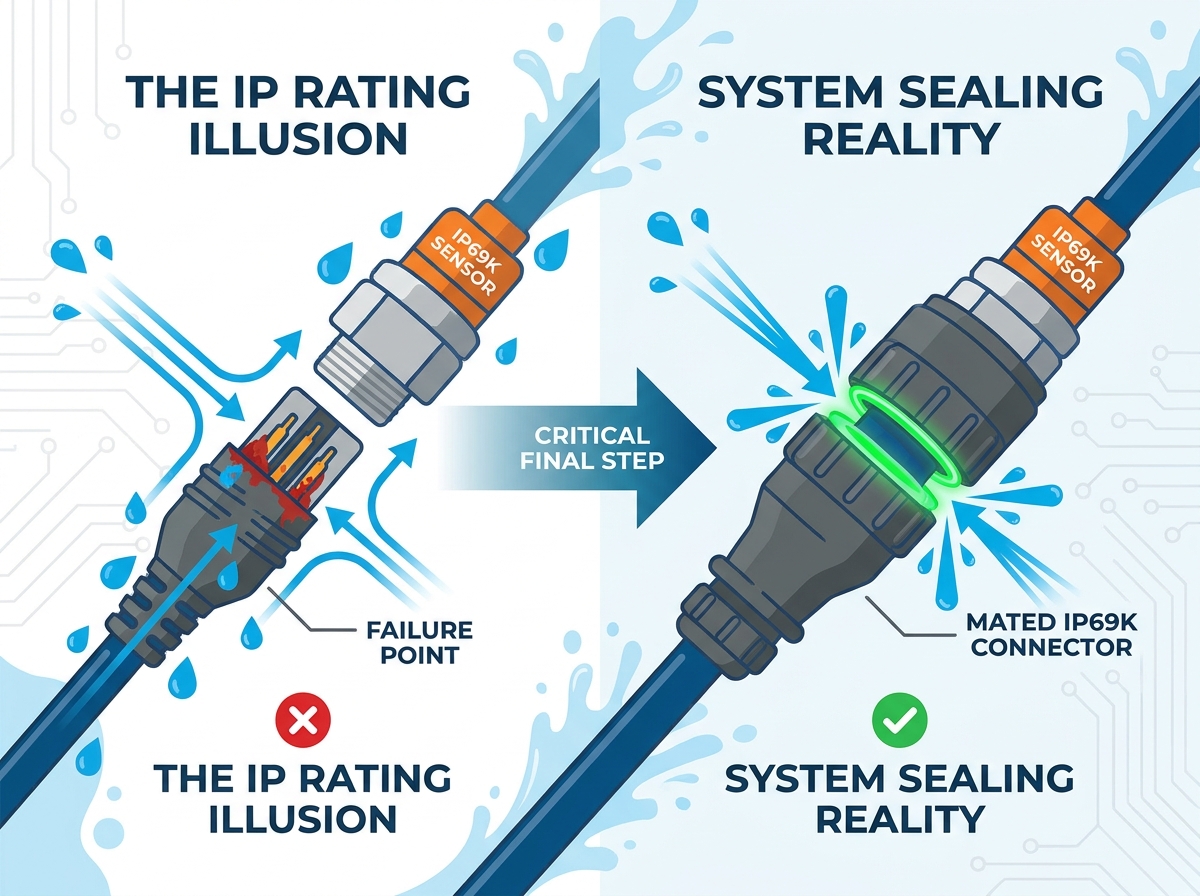
Engineers routinely encounter a frustrating and costly oversight during system design. They specify a premium, IP69K-rated sensing device, only to experience severe liquid ingress failures in the field. This unexpected breakdown paralyzes operations and damages engineering reputations. The reality is quite simple but heavily ignored across industries. An IP69K rating on a datasheet strictly applies to the device housing itself. The entire electrical system remains only as robust as its weakest point. Almost always, this vulnerable point is the connection interface. We must address this mechanical gap to ensure long-term reliability. This article explains why evaluating the mated connection boundary is the critical final step in preventing catastrophic electrical failures. You will learn how high-pressure washdowns expose hidden vulnerabilities in standard designs. We will also explore strict criteria for choosing proper components to survive harsh washdown and heavy-duty environments.
Key Takeaways
Component vs. System Sealing: An IP69K sensor housing does not guarantee an IP69K connection; both halves of the mated pair must be certified and properly installed.
Environmental Realities: High-pressure washdowns and extreme temperature cycling can force moisture past standard threads and seals, causing pin corrosion and capillary action.
Evaluation Criteria: Specifying a true sealed sensor connector requires verifying material compatibility, locking mechanisms, and dynamic vibration resistance, not just the static IP rating.
The IP Rating Illusion: Where Sensor Specs Stop and Failures Begin
Many professionals falsely assume an "IP69K" badge makes the entire assembly waterproof. This assumption creates dangerous operational blind spots. We often see procurement teams purchase a highly rated device and pair it with a standard plug. The internal electronics remain perfectly dry, but the overall system still fails. High-velocity water bypasses the unrated mating boundary. This intrusion leads directly to electrical shorts and signal loss.
The mechanical transition zone requires strict scrutiny from engineering teams. The IP69K standard (ISO 20653 / DIN EN 60529) demands extreme environmental resilience. It tests equipment against intense, close-range water jets reaching 80 to 100 bar. It also applies high-temperature water at exactly 80°C. If the cable side fails to match these extreme ratings, the seal breaks instantly. High-velocity water will easily force its way past a basic O-ring.
A successful deployment means fundamentally changing our engineering mindset. We must move from component-level specifications to system-level ingress protection verification. You have to evaluate the device and its mating cable as a single barrier. Both sides must lock together seamlessly to repel severe environmental threats. An unmatched plug completely nullifies the ruggedness of the main instrument.
Table 1: Component-Level vs. System-Level Verification
Mismatched components rapidly fail when exposed to harsh operating conditions. We document these failures across several demanding industrial sectors. Standard threads simply cannot withstand continuous physical assault from the elements.
Heavy equipment faces intense daily abuse in the field. An off-highway level sensor deals with much more than just occasional rainwater. It continuously battles thick mud, hot hydraulic fluid, and aggressive chemical cleaning agents. Heavy machinery generates severe shock and vibration during standard operations. This constant vibration creates micro-gaps in unsealed mating threads. Once these gaps open, outside fluids quickly seep into the sensitive contact pins.
Liquid storage applications carry their own unique environmental hazards. Consider a fuel tank float level sensor installed on mobile construction equipment. The equipment operates in rapidly shifting weather conditions. Ambient temperature fluctuations cause the tank to "breathe" throughout the day. This breathing creates powerful internal pressure differentials. A vacuum effect actively pulls ambient moisture into unsealed plug housings. Once inside, dangerous condensation forms directly on the internal electronics.
Food and beverage facilities pose extreme chemical and thermal risks. Sanitary environments require daily caustic washdowns to meet rigid health codes. These aggressive chemicals quickly degrade inferior rubber O-rings. Standard commercial plastics become brittle and crack after repeated wash cycles. When the protective outer shell fails, moisture inevitably destroys the internal connection.
Best Practices: Always shield mating zones from direct high-pressure spray paths when possible. Routing cables behind structural barriers greatly extends component lifespan.
Common Mistakes: Assuming a generic protective boot replaces the need for a properly rated mating plug. Boots trap moisture instead of blocking it.
Evaluating an IP69K Level Sensor Connector
Engineers must choose carefully between two main solution categories. Overmolded cable assemblies provide excellent factory-sealed protection for critical nodes. They completely eliminate the numerous risks associated with manual wire terminations. However, field-wireable plugs offer better repairability during emergency maintenance scenarios. Overmolded designs typically show much higher reliability metrics in active washdown zones.
Selecting a true sealed sensor connector requires reviewing specific chemical and material properties. You cannot rely on basic visual inspections.
Housing materials: These play a massive role in overall longevity. Common high-performance choices include reinforced polyamide, stainless steel, or specialized thermoplastics. These must heavily resist UV exposure and caustic cleaning chemicals.
Seal materials: Gaskets dictate how long the water barrier actually lasts. You should precisely match the elastomer to the specific environmental exposure. FKM handles high temperatures and harsh industrial oils. EPDM works exceptionally well for steam and outdoor weather resistance. NBR remains suitable for general-purpose indoor applications.
Mechanical coupling ensures the face seal stays perfectly intact. You cannot rely on friction alone to stop pressurized water. Secure locking mechanisms maintain necessary compression under dynamic mechanical loads. An M12 threaded coupling needs integrated anti-vibration detents to prevent slow loosening. Bayonet locks offer quick, secure connections for environments facing heavy mechanical shock.
Finding concrete evidence of compliance remains a mandatory engineering step. Do not take glossy marketing claims at face value. Look specifically for independent, third-party testing certificates. These technical documents must show the fully mated pair surviving IP69K conditions. The certification is completely useless if it only covers the standalone components. A true IP69K level sensor connector guarantees uninterrupted protection across the entire assembly.
Implementation Risks: The Cost of a Weak Link
Failure to properly secure the connection boundary creates immediate physical risks. Moisture entry initiates a cascade of destructive electrical events.
Capillary action, often called cable wicking, is a fascinating but destructive process. When moisture enters a non-IP69K plug, it does not pool there. Water actively travels down the microscopic spaces between the copper wire strands. It gets pulled directly into the main control cabinet. This invisible leak path ruins expensive hardware located miles away from the initial entry point. We see entire PLC racks destroyed by a single leaking field plug.
Galvanic corrosion quickly adds another severe layer of component failure. Dissimilar metals react strongly when moisture bridges the tiny gap between them. This internal chemical intrusion leads to rapid, unpredictable signal degradation. Operators will notice frustrating intermittent faults before the system entirely shuts down. Troubleshooting these random ghost errors wastes massive amounts of engineering time. Maintenance teams struggle to locate the root cause of the voltage drop.
Saving money on a standard cable creates dangerous false economics. A cheap, unrated plug might save a few dollars upfront. However, it will inevitably destroy a high-value measuring device shortly after installation. Unplanned machine downtime easily consumes any initial, minor component savings. Production lines stop entirely, and maintenance crews must scramble to restore functionality.
Many manufacturers actively protect their businesses from these common installation errors. They will explicitly void warranties on IP69K devices if failure analysis shows improper mating. Factory engineers can easily detect if water entered through an improperly specified plug. If you use the wrong mating cable, you hold the blame. The exact same penalty applies to inadequately torqued coupling threads.
Best Practices: Apply dielectric grease only if explicitly approved by the original equipment manufacturer. Unapproved greases degrade specific sealing elastomers.
Common Mistakes: Over-torquing plastic threads during installation. This deforms the internal O-ring and creates a permanent, invisible leak path.
Shortlisting Logic: Specifying the Complete Assembly
Engineers need a clear, repeatable decision framework to avoid specification errors. Procurement teams must collaborate closely with technical staff during vendor selection. A practical checklist ensures nothing critical falls through the cracks during the ordering phase.
Ask your component suppliers these critical questions before authorizing any purchase:
Is the IP69K rating fully certified for the device while mated with this exact recommended cable?
What are the specific torque requirements needed to achieve the rated seal?
Do you offer factory-overmolded cable solutions to eliminate field-wiring errors entirely?
You must also carefully weigh standardization against proprietary hardware designs. Industry-standard interfaces like M12 or Deutsch plugs offer vast global availability. They work exceptionally well when paired with properly rated sealing boots. Proprietary sealed plugs might offer superior ingress protection for highly specific niches. However, they severely limit your supply chain flexibility during urgent repair scenarios.
Audit your current Bill of Materials (BOM) immediately. Take actionable next steps to secure your deployed hardware assets. Ensure the documented IP ratings of all plugs perfectly match the devices they attach to. A quick, thorough BOM review prevents catastrophic failures in the field.
Conclusion
Purchasing an IP69K device without an equally rated mating plug remains an incomplete engineering solution. You leave the most vulnerable part of the system fully exposed to severe elements. A single mismatched component compromises the entire electrical architecture.
Reliability in harsh environments demands a rigid, holistic approach. Protect your technical investments by designing the connection boundary carefully. Treat the mating plug with the exact same rigor as the measuring instrument itself. Consistent performance requires end-to-end environmental sealing.
Audit your heavy machinery and washdown applications immediately. Contact our application engineering team to review your current instrument pairings. You can also download our comprehensive technical guide on harsh-environment integration to refine your systems further.
FAQ
Q: Can I use an IP67 connector with an IP69K sensor?
A: Only if the environment never exceeds IP67 conditions, like temporary submersion. If the application involves high-pressure, high-temperature washdowns typical of IP69K environments, the IP67 connector will quickly fail. This failure compromises the entire system and leads to costly electrical shorts.
Q: Does overmolding a cable guarantee an IP69K rating?
A: No. While overmolding successfully eliminates the back-end wiring leak path, the front mating interface remains highly vulnerable. The threads, metal pins, and face seal must still be specifically designed and certified to withstand IP69K water pressures and temperatures.
Q: How does vibration affect an IP69K level sensor connector?
A: Constant machine vibration can slowly back off the coupling nut over time. If the mechanical compression on the internal O-ring is lost, the environmental seal is permanently broken. Anti-vibration locking mechanisms are strictly required for heavy-duty applications to maintain constant seal pressure.
Top-rated designer and manufacturer of level-sensor and float-switch