Modern farming relies heavily on precision equipment to maximize yields and protect crops. However, even the most advanced telemetry systems fall short if they rely on faulty fluid measurements. Equipment manufacturers and fleet operators face immense pressure to specify components capable of surviving harsh agricultural environments.
Inaccurate volume tracking directly causes improper application rates, widespread chemical waste, and severe environmental compliance risks. Ag sprayer tanks present highly unique challenges. They subject internal components to aggressive chemicals, violent fluid sloshing, and relentless high-frequency vibration.
This guide provides a transparent, technical framework for evaluating monitoring solutions. We will explore how to select the right sensor technology for your specific fluid dynamics. You will learn how to balance rugged reliability with seamless system integration for long-term field success.
Key Takeaways
Sensor selection must be driven by chemical compatibility (e.g., fertilizers, pesticides) to prevent premature material degradation.
Dynamic operating environments require technologies immune to, or capable of filtering out, fluid sloshing and extreme vibration.
Integration capabilities—specifically matching the sensor output (e.g., analog, digital, or a resistive output agricultural tank sensor) to existing sprayer control modules—dictate ease of implementation.
Defining Success Criteria for Ag Sprayer Tank Monitoring
Mobile agricultural equipment operates under extreme physical stress. Tractors and trailed sprayers endure vast temperature swings across different seasons. They face intense UV exposure in open fields. Physical shock and mechanical vibration remain constant during transit over rough, uneven terrain. Sensors must withstand these operational baselines without losing structural integrity or signal calibration.
Hardware failure carries severe financial and agronomic penalties. Sensor drift leads directly to improper dilution ratios. Over-concentration causes devastating crop burn and soil toxicity. Conversely, under-application results in significant yield loss due to uncontrolled pests or aggressive weed growth. You need hardware built specifically to prevent these outcomes.
This brings us to a specific integration challenge. You need a highly specialized chemical spray tank level sensor because standard industrial water sensors degrade rapidly here. Agricultural mixtures contain harsh surfactants and sticky defoamers. Corrosive liquid fertilizers, like UAN 32, actively attack standard probe materials. A successful specification requires looking beyond basic functionality and focusing on robust chemical defense.
Evaluating Core Sensor Technologies for Mobile Agriculture
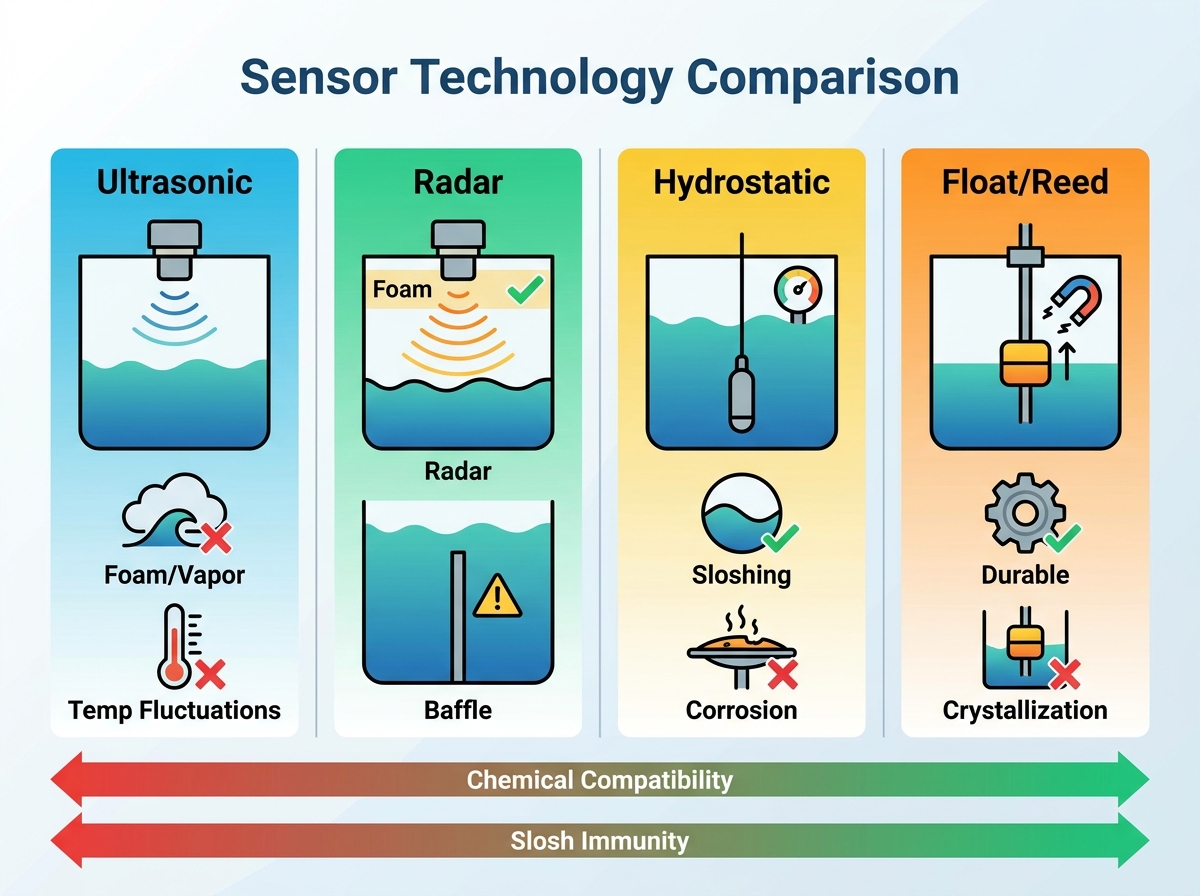
Ultrasonic Sensors
Ultrasonic technology utilizes high-frequency sound waves to measure the distance to the fluid surface. We often see this deployed in simpler tank architectures.
Strengths: They offer a non-contact measurement approach. The technology remains completely immune to liquid density changes. They never touch the fluid, which inherently protects them from chemical corrosion.
Limitations: They are highly susceptible to signal loss from foam, which is very common in ag chemicals. Internal tank condensation and rapid temperature fluctuations also distort acoustic waves, causing erratic readings.
Radar Level Sensors
Radar sensors emit radio frequency waves. They represent a premium tier of liquid measurement for complex agricultural operations.
Strengths: They deliver exceptional accuracy. They remain unaffected by temperature variations, dense vapors, or heavy surface foam. Their non-contact nature significantly extends their operational lifespan.
Limitations: They require a higher initial capital expenditure. Engineers must place them carefully to avoid internal tank obstructions. Baffles or agitators can cause false signal reflections.
Hydrostatic / Submersible Pressure Sensors
These sensors sit at the bottom of the tank. They measure the pressure exerted by the fluid column above them.
Strengths: They are highly reliable for bottom-mounting applications. They handle fluid sloshing exceptionally well when you pair them with proper stilling wells.
Limitations: The sensing diaphragms are highly vulnerable to chemical attack if you specify the wrong housing material. Furthermore, the specific gravity of the fluid must remain constant, or you must recalibrate the system between different chemical batches.
Continuous Float / Reed Switch Sensors
Float sensors use a magnetic float moving along a specialized stem. They trigger internal switches to determine the liquid height.
Strengths: They are mechanically simple. They offer high durability if constructed using correct materials. Technicians find them easily repairable in the field.
Limitations: Mechanical parts easily stick due to chemical crystallization. They demand strict maintenance schedules to prevent residue buildup from jamming the float mechanism.
Integration and Output Considerations
Matching the sensor to the OEM telemetry or in-cab display architecture remains a critical step. A sophisticated sensor provides no value if the tractor's control module cannot interpret its data. You must evaluate the existing electrical ecosystem before selecting a communication protocol.
Engineers usually evaluate 4-20mA and 0-5V analog signals against CAN bus networks. The CAN bus (specifically J1939) allows for advanced diagnostics and multi-node communication. However, analog signals remain incredibly reliable for point-to-point connections in noisy electrical environments.
In many scenarios, older platforms require simple, bulletproof solutions. You might specify a resistive output agricultural tank sensor for legacy equipment retrofits. These units integrate perfectly into simple gauge clusters. They excel in rugged, low-power applications where digital networks add unnecessary complexity.
Power supply realities on mobile equipment also demand attention. Tractors and sprayers experience significant voltage drops during engine cranking. Alternators generate substantial electrical noise. You must select sensors featuring robust internal power regulation to maintain signal stability during these events.
Table 1: Output Signal Comparison for Mobile Agriculture
Signal Type
Best Use Case
Pros
Cons
CAN bus (J1939)
Modern OEM tractor telemetry
Advanced diagnostics, high data integrity
Complex programming required
4-20mA Analog
Long cable runs, noisy environments
Highly immune to voltage drops
One-way data transmission
0-5V / 0-10V
Short distance, shielded connections
Simple to troubleshoot
Susceptible to ground loops
Resistive
Legacy gauge clusters, simple systems
Rugged, requires no digital processing
Lower resolution than digital
Material Selection and Chemical Compatibility
Wetted parts matter immensely. The physical materials touching the fluid determine the entire lifespan of the unit. You cannot compromise here. We strongly recommend specifying PVDF, PTFE (Teflon), or high-grade 316L stainless steel depending on the payload. Standard plastics will crack under UV light and chemical exposure.
Seals and gaskets often serve as the weakest link in the assembly. Standard EPDM or Buna-N components fail rapidly when exposed to specific herbicides. They swell, crack, and ultimately leak. You should mandate Viton (FKM) or Kalrez seals whenever handling aggressive agrochemicals. These premium elastomers resist chemical attack and maintain compression in extreme temperatures.
We advise taking an evidence-oriented approach to specification. Always cross-reference the sensor’s material specification sheet with the safety data sheets (SDS) of your chemicals. Identify the most aggressive mixtures the sprayer will carry. Ensure every wetted component holds a top-tier compatibility rating for those specific compounds.
Implementation Risks and Field Maintenance Realities
Managing fluid slosh requires deliberate engineering. Mobile tanks experience violent agitation. We mitigate this using physical baffles or protective stilling wells around the probe. Additionally, modern systems use software-side moving-average filters. These algorithms smooth out the raw data, preventing erratic gauge readings as the machine traverses rough terrain.
Residue buildup presents a constant operational reality. Chemical crystallization and biological growth occur inside every tank. You must factor cleaning procedures into sensor placement. Ensure flush-mount sensors do not create dead legs where chemicals can pool and harden. Technicians need easy access to wipe down components during routine washdowns.
Vibration fatigue causes catastrophic structural failure in poorly chosen components. Rigid probes often snap at the mounting thread when subjected to boom vibration. To ensure absolute structural integrity, an agricultural sprayer tank level sensor must feature a reinforced base. Flexible probes or non-contact radar solutions are highly preferred for high-vibration booms and large-capacity tanks.
The Shortlisting Framework: Next Steps for Procurement
Selecting the right equipment requires a disciplined approach. Follow these structured steps to narrow down your options and avoid procurement mistakes.
Define the Chemical Profile: List all potential tank mixtures. Document every fertilizer, surfactant, and pesticide the machine might encounter. Use this list to dictate wetted materials.
Determine Tank Geometry & Agitation: Map out internal baffles and mechanical agitators. Identify physical obstructions that could interfere with rigid probes or scatter radar signals.
Specify the Output: Align early with your electrical engineering team. Decide whether the platform requires CAN bus architecture, 4-20mA robustness, or basic resistive outputs.
Request Testing Validations: Ask manufacturers for documented vibration testing data. Look for MIL-STD or ISO standard compliance. Always field-test a pilot unit before committing to a fleet-wide rollout.
Conclusion
Selecting the right sensor remains a balancing act between chemical resilience, integration simplicity, and immunity to dynamic field conditions.
Avoid over-specifying technology where simple solutions work perfectly well.
Never compromise on wetted-material compatibility; it dictates the survival of the instrument.
Consult directly with a specialized sensor application engineer to validate your choices.
Request a technical datasheet and test a sample unit to prove performance in your specific tank architecture before finalizing bulk orders.
FAQ
Q: How do I prevent false readings from liquid sloshing in a moving sprayer?
A: You can manage sloshing through two main methods. First, install physical stilling wells around contact probes to mechanically calm the fluid. Second, implement software-side moving-average filters within the control module. These algorithms delay signal updates, smoothing out rapid fluctuations caused by rough terrain.
Q: Are non-contact sensors always better for chemical tanks?
A: Not always. Non-contact sensors avoid corrosion since they never touch the fluid. However, they struggle with heavy foam, which absorbs ultrasonic waves and disrupts radar signals. Contact sensors handle foam easily but require strict material compatibility to survive aggressive chemicals.
Q: Can I retrofit a modern digital sensor onto an older analog sprayer control?
A: Yes, you can use signal conversion modules to bridge the gap. However, it is often much simpler and more reliable to specify a resistive or voltage output sensor designed specifically to interface directly with older, legacy gauge clusters without needing extra hardware.
Q: How often should agricultural level sensors be recalibrated?
A: Recalibration frequency depends on the technology and fluid. Hydrostatic sensors may require seasonal recalibration if fluid density changes. Radar and ultrasonic sensors rarely drift. However, all contact sensors demand routine physical cleaning to remove residue buildup, which affects accuracy more than electrical drift.
Top-rated designer and manufacturer of level-sensor and float-switch