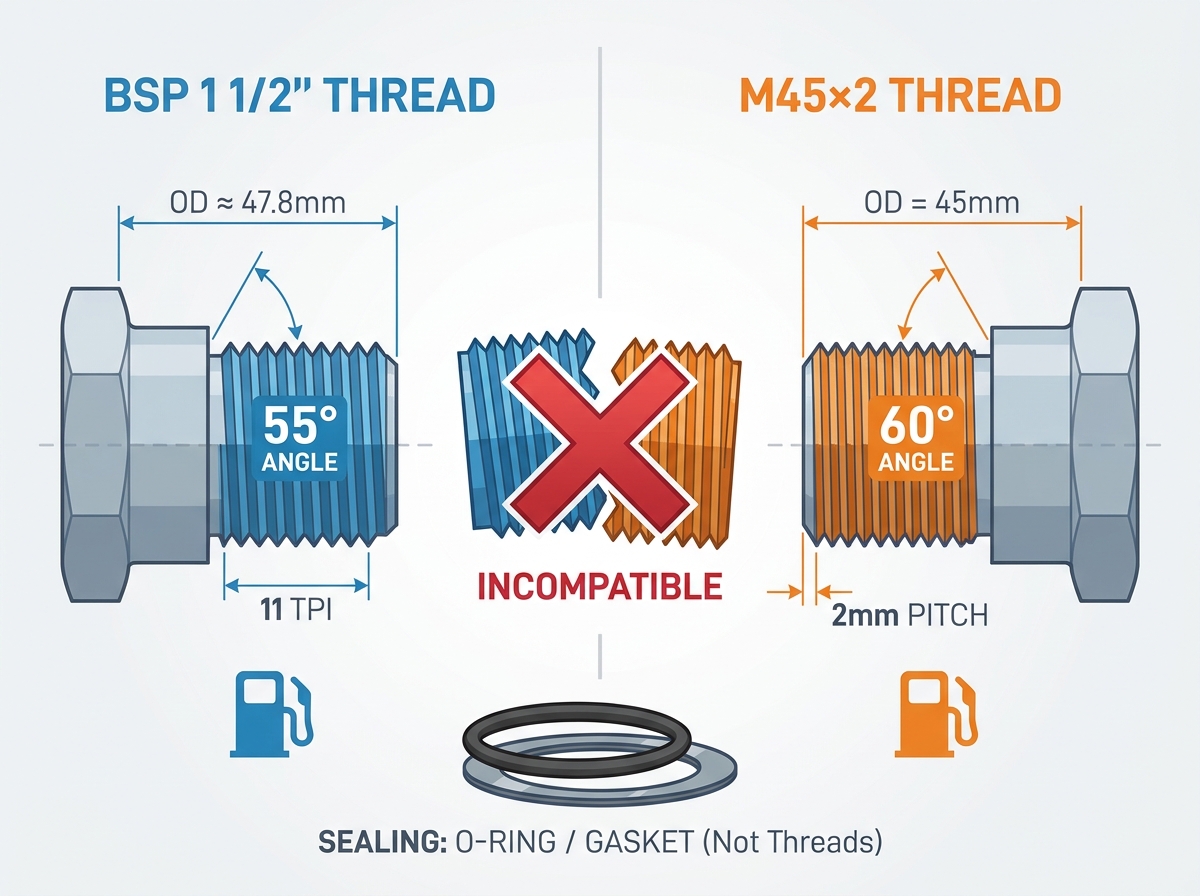
Equipment reliability heavily depends on precise component matching. Nowhere is this more obvious than in fuel storage systems. Mismatched threads routinely invite cross-threading, vacuum leaks, and dangerous fuel spills. Specifying the wrong gauge for a threaded fuel tank port creates immediate safety compliance risks. It also leads to expensive and frustrating equipment downtime.
To prevent these failures, engineering and procurement teams must fully understand their exact port dimensions. Usually, the choice between BSP and M45×2 dictates compatibility. This structural choice depends heavily on regional manufacturing standards and specific generator tank designs. In this guide, we evaluate the distinct mechanical differences between these two common standards. You will learn how to accurately measure existing ports, avoid common procurement errors, and confidently specify the correct replacement parts for your power generation equipment.
Key Takeaways
Standard Differentiation: BSP (British Standard Pipe) relies on a 55-degree thread angle and imperial scaling, while M45×2 uses a 60-degree angle with a strict 45mm outer diameter and 2mm pitch.
Application Context: A BSP 1 1/2 mechanical fuel gauge is standard in many UK/European and legacy industrial tanks, whereas an M45x2 mechanical level gauge is increasingly common in modern metric-based machinery and Asian-manufactured equipment.
Sealing Realities: Both thread types in fuel gauge applications typically require an O-ring or flat gasket under the flange rather than relying purely on thread interference for sealing.
Verification Rule: Never force a thread. Use digital calipers and a thread pitch gauge to confirm the female port specifications before ordering.
Technical Specifications: BSP vs M45x2 Fuel Gauge Thread
Understanding the fundamental geometry of these two standards reveals why they behave so differently in the field. Thread profiles dictate how male and female components interlock under stress. When we compare these specifications, we see two entirely distinct engineering philosophies at work.
Defining the BSP Standard (Typically 1 1/2" for Gauges)
The British Standard Pipe (BSP) thread is a globally recognized sealing standard. Equipment manufacturers rely on the Whitworth thread form for these connections. This specific geometry features a 55-degree angle between the thread peaks. It also utilizes rounded roots and crests, distributing mechanical stress evenly across the connection.
Many technicians become confused by BSP sizing conventions. The designation "1 1/2 inch" refers exclusively to the nominal pipe bore, not the physical outer diameter. The actual major diameter (outer physical dimension) measures approximately 47.8mm. Furthermore, a 1 1/2" BSP connection utilizes exactly 11 threads per inch (TPI). This imperial spacing remains consistent across this specific size category, regardless of the component material.
Defining the Metric Standard (M45×2)
Modern engineering frequently leans toward ISO metric thread profiles. The M45×2 standard represents a highly precise, straightforward metric application. Unlike the rounded 55-degree Whitworth form, this metric standard uses a sharp 60-degree angle. This profile aligns perfectly with global ISO machining standards.
Metric naming conventions leave no room for ambiguity. The "M45" directly indicates an exact 45mm major outer diameter. The "×2" denotes a 2.0mm pitch. Pitch represents the literal distance between two adjacent thread peaks. This precise scaling makes the metric standard highly predictable during custom tank fabrication and global supply chain sourcing.
Why They Cannot Be Interchanged
You cannot mix these two standards. A severe 2.8mm discrepancy exists between the 47.8mm BSP outer diameter and the 45mm metric diameter. If you attempt to mate them, the geometries simply clash. The differing angles (55 degrees versus 60 degrees) prevent proper face-to-face contact.
Attempting to thread an M45x2 male gauge into a BSP 1 1/2 female port results in immediate failure. The male component will sit too loosely inside the larger female port. Conversely, forcing a BSP gauge into an M45x2 port requires extreme mechanical force. This action crushes the thread crests, shreds the port material, and permanently destroys the tank bung.
Evaluation Dimensions for Thread-in Genset Fuel Gauges
Selecting the right component involves more than just reading a spec sheet. Field conditions heavily influence how these components behave. We must evaluate origin ecosystems, sealing requirements, and material durability before finalizing any maintenance plan.
Equipment Origin and Ecosystem
The origin of your equipment often dictates your required thread standard. European and UK legacy generator sets traditionally utilize BSP ports. Supply chains in these regions standardized around Whitworth forms decades ago. Standard weld-on tank flanges from these regions almost universally feature BSP tapping.
Modern global configurations tell a different story. Asian manufacturers heavily favor ISO metric standards. Newly fabricated machinery increasingly integrates M45x2 ports to align with metric hardware ecosystems. Understanding the origin of your specific fuel tank provides the strongest initial clue regarding port compatibility.
Sealing Methodology and Vibration Tolerance
Threads alone rarely provide adequate fluid sealing in these specific instruments. A secure seal requires an O-ring or flat gasket positioned under the gauge flange. When you tighten the component, the flange compresses the elastomer against the flat surface of the tank boss. This compression prevents fuel vapors and liquid from escaping.
Diesel generators produce intense, continuous vibration. This mechanical shaking tests every connection. If threads bind improperly before the flange seats fully, the gasket remains uncompressed. Inadequate compression inevitably leads to leaks. Proper flange seating matters far more than extreme thread tightness. Correctly matched threads allow the component to spin smoothly until the gasket engages.
Durability and Material Factors
Gauges often utilize aluminum or heavy-duty plastic headers. Tank ports typically consist of welded steel or heavy aluminum. When you combine different materials, friction becomes a primary concern. Incorrectly machined or mismatched threads dramatically increase this friction.
Galling poses a significant risk during installation. Galling occurs when friction localized welding causes metal surfaces to tear and fuse. If you force an incompatible thread, the softer aluminum header will instantly gall against a steel port. This permanently locks the gauge in place or strips the threads entirely. Clean, perfectly matched geometries prevent this costly structural failure.
Implementation Realities and Diagnostic Measurement
Assumptions lead to expensive mistakes in the field. We strongly recommend mandatory physical verification before ordering replacement parts. Accurate diagnostic measurement eliminates guesswork and protects your hardware investments.
How to Identify Your Existing Tank Port
Do not rely on visual inspections alone. Follow this strict diagnostic process to identify your port:
Measure the Diameters: Use high-quality digital calipers. If removing the old gauge, measure its major (outside) diameter. If measuring the empty tank port, measure the minor (inside) diameter. A reading near 45mm strongly indicates an M45x2 configuration. A reading closer to 47.8mm confirms a BSP 1 1/2 setup.
Verify the Pitch: Apply a mechanical thread pitch gauge to the threads. Find the blade that drops perfectly into the grooves. Confirm whether the spacing matches exactly 2.0mm or aligns with an 11 TPI imperial scale.
Inspect the Sealing Face: Check the flat surface surrounding the female port. Ensure it remains clean and free of deep scratches. A damaged sealing face will leak regardless of correct thread matching.
Common Rollout Risks in Procurement
Procurement teams face several hidden traps when sourcing these components. The most dangerous is the "Looks Close Enough" fallacy. Because 45mm and 47.8mm appear visually similar from a distance, technicians often assume they hold the correct part. They apply heavy wrenches to force the connection, instantly stripping the tank bung.
Another widespread error involves geographical assumptions. Many engineers assume metric countries strictly use metric pipe threads. This is entirely false. BSP remains globally ubiquitous in fluid piping, even deeply within metric-dominant regions. You cannot assume an M45x2 requirement simply because the generator was manufactured in a metric-using nation. Verification remains non-negotiable.
Decision Framework: Which Gauge Standard to Specify?
A structured decision framework simplifies the procurement process. By categorizing your specific application, you can confidently shortlist the appropriate component. Below, we outline exactly when to deploy each standard.
Table: Fuel Gauge Thread Specification Matrix
Standard Name
Nominal Size
Actual OD
Thread Angle
Pitch / TPI
Primary Ecosystem
BSP 1 1/2
1.5 Inch
~47.8mm
55 Degrees
11 TPI
Legacy European, UK equipment
Metric M45x2
M45
45.0mm
60 Degrees
2.0mm Pitch
Modern Asian, ISO Metric designs
When to Shortlist the BSP 1 1/2 Mechanical Fuel Gauge
You should specify the BSP option under very specific legacy conditions. Choose this standard when replacing an existing gauge that measures approximately 47.8mm across the outer threads. It acts as a perfect drop-in replacement for these older tanks.
Additionally, select BSP when integrating components with standard plumbing fittings from European or Commonwealth suppliers. Many established tank manufacturers explicitly specify BSPP (parallel) or BSPT (tapered) standards in their technical drawings. Always honor the original manufacturer documentation when making these selections.
When to Shortlist the M45x2 Mechanical Level Gauge
The M45x2 option shines in modern, globally standardized environments. Specify this component when dealing with new metric equipment, particularly units sourced from major Asian manufacturing hubs. The exact 45mm sizing integrates flawlessly into these modern designs.
You should also select M45x2 during custom tank fabrication. When welders install an M45x2 weld-on boss, you must match it precisely. Finally, choose this standard for large-scale production runs where strict ISO metric standardization is legally required across the entire Bill of Materials (BOM).
Conclusion
The choice between BSP and M45×2 is strictly dictated by existing female tank port geometry. These two standards are entirely mutually exclusive options. You cannot bridge the 2.8mm diameter gap or the differing thread angles through excessive force or sealants.
To ensure safe and reliable installations, keep these action steps in mind:
Mandate strict caliper and pitch gauge verification before finalizing any purchase orders.
Train maintenance technicians to recognize the difference between 55-degree Whitworth and 60-degree metric forms.
Never rely on thread binding for fluid sealing; always ensure proper O-ring compression beneath the flange.
Immediately stop installation if a component requires excessive torque to spin into the port.
Protect your generator infrastructure by treating thread verification as a critical safety procedure. As a clear next step, contact your technical sales representative with exact tank port measurements. This ensures you receive the correctly threaded gauge and the precisely matched O-ring kit required for a leak-free installation.
FAQ
Q: Can I use thread seal tape to make an M45x2 gauge fit a BSP port?
A: No. The diameter difference is too large (almost 3mm). Tape will not bridge this gap, and the gauge will blow out under pressure or leak heavily. Relying on tape for this massive discrepancy creates severe safety and environmental hazards.
Q: What is the standard thread for a generator fuel tank?
A: There is no single global standard. A thread-in genset fuel gauge typically uses either BSP 1 1/2" or M45x2, depending entirely on the manufacturer's region and the specific tank design. Always measure your port directly.
Q: Does a BSP 1 1/2" thread actually measure 1.5 inches across?
A: No. The 1 1/2" refers to nominal bore size. The actual outer diameter of the threads is roughly 1.88 inches (47.8mm). This naming convention frequently confuses technicians, making caliper verification essential.
Q: Do these mechanical gauges require a gasket?
A: Yes. Regardless of whether you use BSP or M45x2, mechanical fuel level gauges typically seal via an O-ring or flat gasket compressed beneath the mounting hex, not via the threads themselves. The threads merely provide the clamping force.
Top-rated designer and manufacturer of level-sensor and float-switch