
- All
- Product Name
- Product Keyword
- Product Model
- Product Summary
- Product Description
- Multi Field Search


Views: 0 Author: Site Editor Publish Time: 2026-09-21 Origin: Site


Atmospheric water generators rely on precise level sensing for much more than basic inventory tracking. These advanced systems demand exact measurements to control energy-intensive compressor cycles. Precision also prevents catastrophic overflow events. The water produced presents unique challenges for mechanical engineers. Because it condenses directly from ambient air, it lacks dissolved minerals initially. This makes the water highly purified and electrically insulative. It also remains slightly corrosive to standard plumbing materials. Furthermore, storing this water requires strict compliance with sanitary standards. You must ensure human safety at all times. This guide provides a comprehensive technical framework for evaluating sensing technologies. You will learn how to select the right components to maintain safe operations. We explore material selection, environmental mitigation, and system integration strategies. This knowledge ensures continuous and optimal machine performance.
AWG water’s ultra-low conductivity renders standard conductivity probes unreliable, necessitating mechanical, optical, or ultrasonic alternatives.
Food-safe material compliance is non-negotiable; specifying a 316 stainless steel water level sensor prevents metal leaching and resists the aggressive nature of pure water.
Sensor placement must account for high-humidity environments, condensation buildup, and mechanical vibrations from the AWG’s internal compressor.
Selecting the right atmospheric water generator level sensor directly impacts energy efficiency by accurately triggering auto-shutoff logic.
Condensed atmospheric water behaves exactly like distilled water. It lacks the free ions required to conduct electricity. This low-conductivity problem causes major design headaches. Traditional conductive probes simply fail to function reliably. They rely on an electrical circuit closing through the liquid. When you measure pure water, the circuit remains open. This false open state tricks the controller. The controller assumes the reservoir remains entirely empty.
If a standard conductive probe fails, the system might continuously run the cooling compressor. This wastes massive amounts of electricity. It also risks flooding the internal chassis. Water overflowing onto high-voltage electrical components causes immediate short circuits. You must prevent these dangerous scenarios through proper component selection.
Sanitary standards further complicate the engineering process. The storage environment poses a high risk for microbial growth. If water stagnates, bacteria can rapidly multiply. Non-food-grade sensor materials also introduce severe health risks. We must treat the reservoir as a food-contact surface. You cannot compromise on material safety standards.
Finally, pure unmineralized water acts as a "hungry" solvent. The aggressive solvent effect accelerates the degradation of basic plastics. Materials like basic PVC break down quickly. Lower-grade metals also corrode at an alarming rate. Over time, these materials leach toxic chemicals into the drinking supply. Effective AWG water tank level monitoring requires specialized components. You must select parts designed to withstand this unique environment safely.
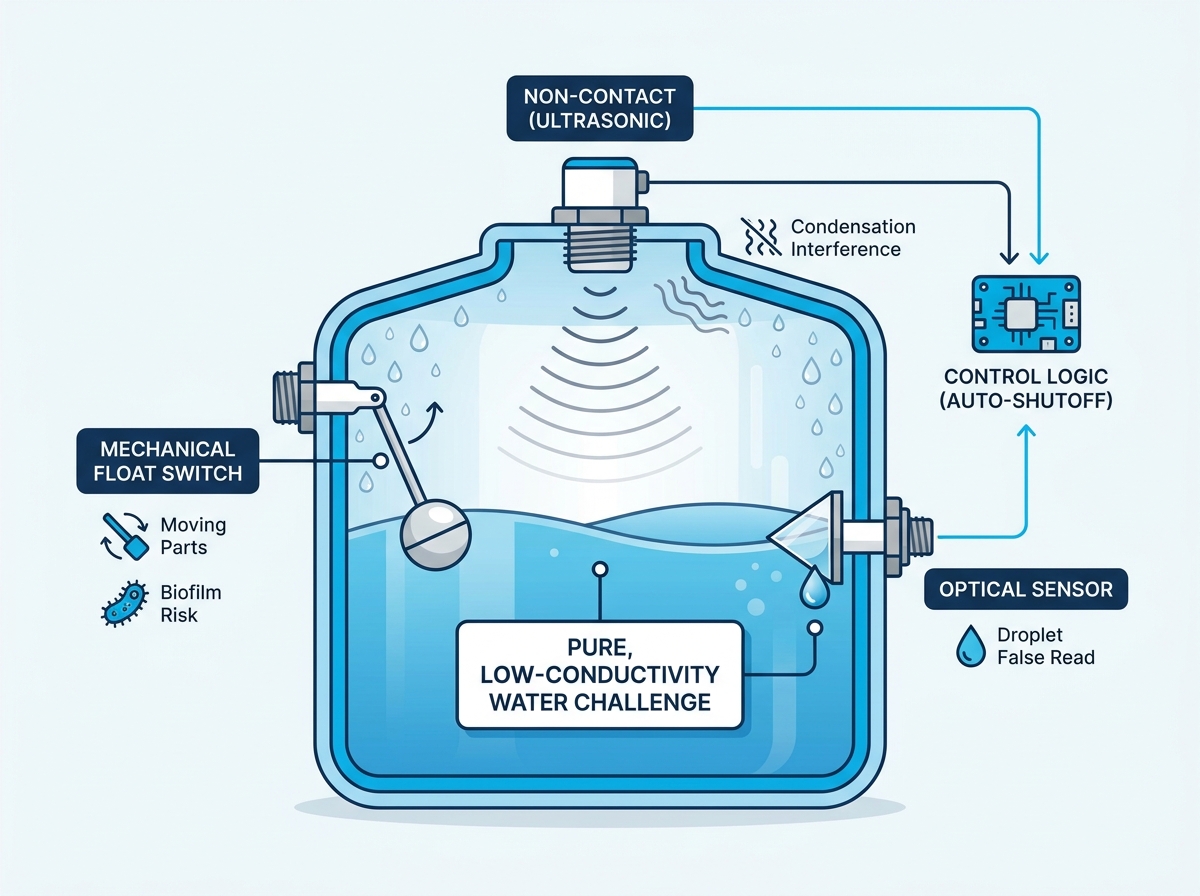
Engineers must carefully weigh the pros and cons of different technologies. Each option behaves differently inside a high-humidity chamber. We will analyze the three most common sensing categories below.
Mechanical float switches offer a highly reliable choice. They operate using a simple magnetic reed switch mechanism. They remain entirely unaffected by water conductivity. They provide a cost-effective solution for both residential and commercial units. However, their physical moving parts face distinct challenges. They are susceptible to mineral scaling over time. This happens frequently if you install them near post-mineralization filters. Biofilm buildup can also restrict their physical movement. A stuck float causes immediate system failures.
Ultrasonic and capacitive sensors provide a modern non-contact alternative. They emit sound waves or measure capacitive fields. They have zero direct contact with potable water. This non-contact design eliminates physical contamination risks completely. Unfortunately, heavy condensation inside the chamber causes severe problems. Droplets can create false acoustic echoes. They also induce capacitive baseline drift. Engineers must implement advanced signal conditioning algorithms. You need smart software to filter out these false readings efficiently.
Optical liquid level sensors offer a very compact footprint. They use infrared light refraction to detect liquid presence. They are extremely accurate for pinpoint high and low detection. This makes them ideal for critical auto-shutoff triggers. Yet, they remain prone to false readings in humid spaces. Water droplets often cling tightly to the sensor prism. High internal humidity exacerbates this droplet clinging issue. A clinging droplet mimics a full reservoir state.
Table: Sensor Technology Comparison for AWGs
Technology Type | Primary Advantage | Primary Disadvantage | Best Use Case |
|---|---|---|---|
Mechanical Float | Ignores low conductivity | Susceptible to scaling | Basic commercial units |
Ultrasonic (Non-Contact) | Zero contamination risk | Condensation interference | High-end smart displays |
Optical Sensor | Highly accurate point detection | Droplets cause false triggers | Critical safety shutoff |
Material science clearly separates 304 and 316 stainless steel alloys. The deliberate addition of molybdenum defines the 316 alloy. This specific element drastically improves pitting resistance. It also boosts general corrosion resistance significantly. When exposed to highly purified water, 316 SS holds up exceptionally well. The aggressive nature of unmineralized water easily attacks lesser metals. Even standard 304 stainless steel eventually succumbs to microscopic pitting.
Regulatory alignment provides another compelling reason to upgrade immediately. This superior alloy naturally aligns with stringent FDA guidelines. It also meets NSF/ANSI 61 and WRAS testing standards. These global standards govern safe drinking water system components. Using pre-approved materials protects manufacturers from regulatory compliance violations. It also speeds up the overall product certification process.
The testing methodologies for NSF/ANSI 61 are incredibly rigorous. Technicians submerge materials in various aggressive solvents for weeks. They then test the liquid for trace heavy metals. The 316 alloy consistently passes these extreme tests. It forms a passive oxide layer to protect the underlying iron. This self-healing layer stops rust before it ever begins.
Lifecycle durability requires looking past initial procurement tags. Plastic floats carry a much lower upfront price. However, their long-term structural viability remains remarkably poor. A 316 stainless steel water level sensor eliminates the risk of premature failure. It actively prevents costly and damaging water contamination recalls. Prioritizing high-grade steel ensures sustainable daily operations. It safeguards public health while protecting your brand reputation over decades.
Compressor vibration isolation represents a major electromechanical design hurdle. The continuous hum of a refrigeration compressor generates strong vibrations. These kinetic forces cause mechanical floats to bounce rapidly. This physical bouncing sends erratic, rapid-fire signals straight to the control board. We strongly recommend programming digital hysteresis into your microcontroller. This software logic debounces the raw incoming signal. It smooths out false triggers by requiring sustained signal states.
When setting up your PLC logic, use a debounce timer. A delay of 500 to 1000 milliseconds works perfectly. If the float bounces for 200 milliseconds, the software ignores it. Only a sustained signal triggers a system state change. This simple programming trick extends the life of your compressor relays tremendously.
Condensation and splash interference present similar operational challenges. Freshly condensed water constantly drips down into the holding area. You must consciously place sensors outside the direct drip path. Droplets falling directly onto the hardware cause erratic behavior. Shielding components from heavy internal condensation prevents premature auto-shutoff events. Physical splash guards or baffles offer excellent mitigation strategies. They protect the delicate measuring mechanisms from turbulent water movement.
Finally, integration with control logic demands careful software planning. The hardware output must map perfectly to machine operational states. An analog 4-20mA loop signal tracks continuous volume changes effortlessly. A discrete digital on/off signal works best for high-level safety shutoffs. When the stored volume drops, the logic triggers the refrigeration cycle. When the reservoir fills completely, the unit safely enters standby mode. A reliable atmospheric water generator level sensor seamlessly manages these vital transitions.
Selecting the best component requires a systematic and documented approach. Ad-hoc purchasing decisions often lead to catastrophic field failures. Follow these logical steps to specify the optimal part for your next build.
Determine the Output Requirement: Decide carefully between continuous monitoring and point-level detection. Smart digital displays need continuous volume tracking for user feedback. Simple hardware safety switches only need definitive high and low point detection. Match the physical output type to your motherboard capabilities.
Assess the Tank Geometry: Match the component footprint directly to the available physical space. Vertical versus horizontal mounting dictates the exact float design required. It also determines ideal optical sensor positioning. Ensure you leave adequate clearance for maintenance and regular manual cleaning.
Verify Certifications: Mandate official vendor documentation before making any bulk purchase. Request documented proof of material compliance. Look for current RoHS compliance and FDA-grade material certificates. Never trust undocumented verbal claims regarding public food safety.
Execute Prototype Testing: Always request prototype samples from your shortlisted vendors. Install them inside an active, running test unit. Observe their behavior under actual heavy condensation and extreme vibration conditions. Document any baseline drift or mechanical sticking during these trials.
Effective water tank measurement balances strict sanitary compliance with material durability. It also requires exceptional environmental robustness. You must protect the absolute purity of the harvested water. Simultaneously, you must tightly control energy-intensive cooling cycles.
Prioritizing high-grade materials mitigates long-term material degradation risks. Shielding sensitive components from internal condensation prevents frustrating false signals. Isolating hardware from compressor vibration ensures stable controller logic. Taking these proactive steps ensures your system delivers safe drinking water continuously.
Implement these engineering best practices to avoid unexpected operational downtime. Thoroughly test your selected components in real-world environmental chambers. Protect your end-users by specifying only certified, food-grade materials. Robust design choices build lasting consumer trust in atmospheric water technology.
A: Atmospheric water generation produces pure water with virtually zero dissolved solids, making it an electrical insulator that prevents conductivity sensors from closing a circuit.
A: Heavy condensation on the sensor face can scatter ultrasonic waves or alter capacitive fields, leading to false "tank full" readings and prematurely shutting down water production.
A: While generally safe, 304 stainless steel is more susceptible to localized corrosion over time when exposed to the aggressive nature of highly purified, unmineralized water compared to 316 stainless steel.
