
- All
- Product Name
- Product Keyword
- Product Model
- Product Summary
- Product Description
- Multi Field Search


Views: 0 Author: Site Editor Publish Time: 2026-09-07 Origin: Site


Almost every camper eventually faces the same frustrating scenario. You empty your waste tanks completely, yet the monitor panel still reads "2/3 full." This false reading typically happens because internal fouling blocks accurate measurements. Upgrading your monitoring system permanently solves this annoying problem.
However, choosing the right replacement components requires careful thought. You must balance technological reliability, tank material constraints, and installation accessibility. Upgrading isn't just about replacing cheap parts. It involves migrating to a sensor architecture built specifically for your lifestyle. A full-time off-grid setup demands entirely different hardware than a rig used for occasional weekend hookups.
Matching your equipment to your real-world usage ensures you never guess your fluid levels again. In this guide, you will learn why factory probes fail so often. We will evaluate external capacitive options, precision pressure transducers, and standard conductive probes. You will also discover how to navigate complex wiring and smart system compatibility to guarantee a seamless upgrade.
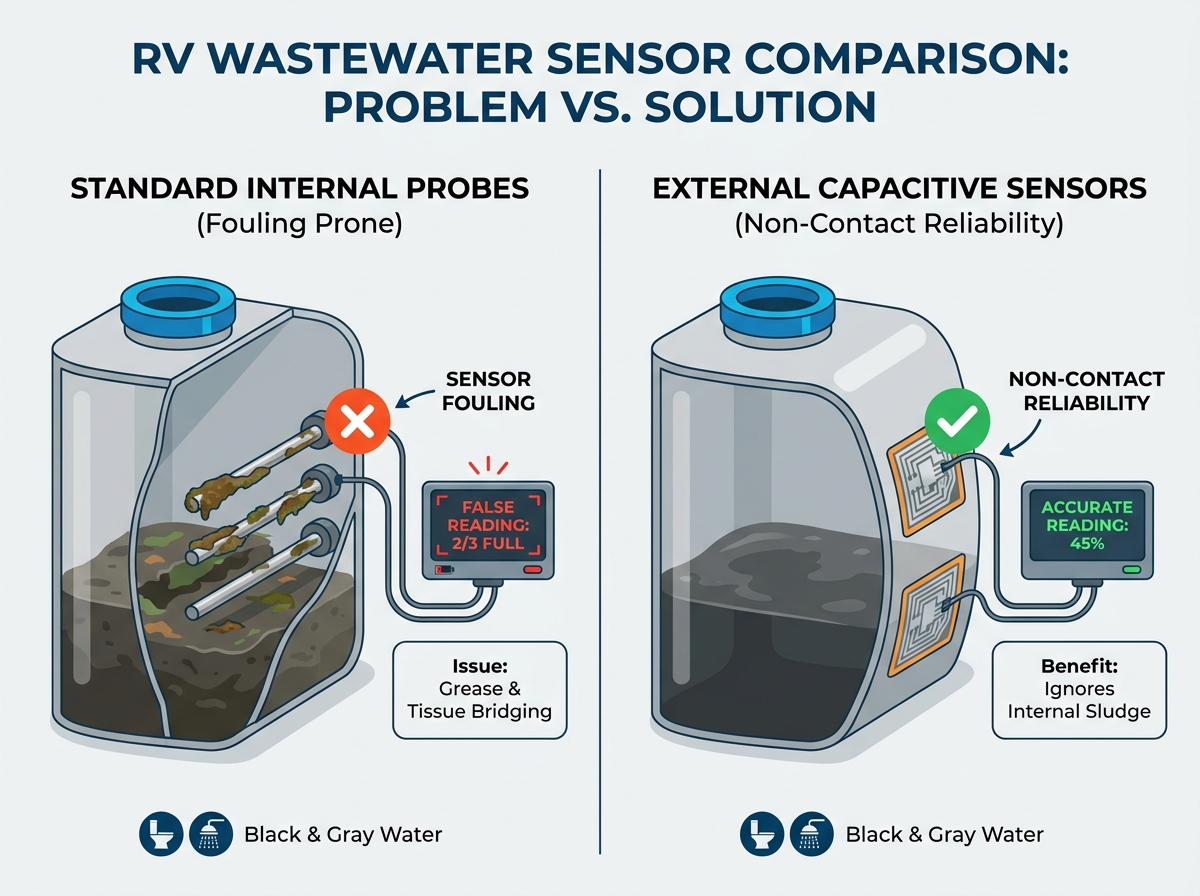
Standard internal probe sensors are sufficient for fresh water but highly prone to false readings in gray and black tanks due to grease and tissue bridging.
External capacitive sensors offer the highest long-term reliability for wastewater because they never contact the tank contents.
System compatibility is critical; replacement sensors must match the electrical resistance (ohms) of your existing monitor panel or smart RV system (e.g., iN-Command, BMPRO).
Installation feasibility often dictates the choice, as accessing enclosed underbellies can exceed the cost and effort of the sensor itself.
Factory-installed tank monitors usually rely on internal conductive probes. These cheap sensors feature a major structural flaw. Through-wall metal probes rely on electrical continuity to measure fluid. The water inside completes an electrical circuit between the probes. Unfortunately, wastewater contains solid debris.
Struvite crystals, bacon grease, and wet wipes inevitably cling to these internal metal pins. This debris creates a permanent physical bridge. The electrical current travels across this sludge bridge instead of the water. Your panel then displays false positive readings.
You must accurately distinguish between a falsely reading sensor and hardware failure. A fouled sensor usually requires aggressive chemical cleaning to dissolve the bridging material. However, a shorted wiring harness or a dead resistor network means cleaning will not help. You will need a complete RV holding tank level sensor replacement to restore functionality.
Ignoring this failing hardware carries a high cost of inaction. A false empty reading on a black tank can lead to a disastrous overflow inside your bathroom. Conversely, a false full reading on your fresh supply might leave you unexpectedly out of water during remote boondocking. Reliable data prevents ruined camping trips.
Many RV owners spend hundreds of dollars on harsh chemical digesters trying to clean sensors. If the underlying wiring has corroded, no amount of chemical treatment will fix the reading. Always verify electrical continuity before buying expensive tank chemicals.
Upgrading requires understanding the three primary technologies available on the market today. Each design presents unique advantages and specific installation limitations.
Pros: They feature a very low upfront cost. Sourcing replacements is incredibly easy. They integrate effortlessly with almost every factory monitor panel.
Cons: They demand high maintenance. Fouling in wastewater remains completely inevitable.
Best for: Budget-conscious repairs and clean fresh water applications.
Pros: They boast zero fluid contact. The sensors completely ignore internal sludge. They provide continuous percentage-based readings (1-100%) rather than vague 1/3 increments.
Cons: They require specific plastic tank wall thicknesses. They absolutely will not work on metal holding tanks.
Best for: Delivering long-term reliability in plastic or polyethylene tanks.
Pros: They offer pinpoint accuracy. Tank wall materials and exterior condensation do not affect their performance.
Cons: They carry a significantly higher cost. Installation is complex. They generally require top-down tank access for proper mounting.
Best for: Custom van builds, unusually deep tanks, and high-end off-grid setups.
Technology Type | Fluid Contact | Ideal Tank Material | Main Advantage |
|---|---|---|---|
Conductive Probes | Yes (Direct) | Any Material | Low Cost |
Capacitive Pads | No (External) | Plastic/Polyethylene | Zero Fouling |
Pressure Transducers | Yes (Submerged) | Any Material | Pinpoint Accuracy |
You do not need to use the exact same technology across all your fluid tanks. Each tank faces different environmental stressors. Customizing your approach often yields the best performance.
When selecting a new RV fresh water tank level sensor, you must emphasize accuracy over fouling resistance. Fresh water does not contain grease, tissue, or struvite. Therefore, internal probes rarely foul or fail in this environment.
Your key evaluation metric here is data granularity. Off-grid campers need to know exactly how many gallons remain to pace their water usage. Standard probes only tell you when you hit 33% or 66%. A pressure transducer or a continuous strip sensor provides exact percentage readouts. This precision prevents unexpected dry taps in the wilderness.
Wastewater tanks present a hostile environment. You must emphasize environmental resilience above all else. Black water contains aggressive solids and tissues. Gray water introduces galvanic corrosion risks from heavy soaps, trapped food particles, and fats.
These harsh variables require non-contact or highly shielded measuring solutions. A premium RV wastewater tank sender must remain completely immune to struvite buildup. It must also withstand aggressive chemical holding tank treatments. Exterior capacitive pads excel here. Because they mount on the outside of the plastic wall, corrosive wastewater never touches them.
Purchasing the best hardware means nothing if you cannot install it properly. You must carefully evaluate your existing infrastructure before buying any kit.
First, evaluate whether the new hardware can communicate with your existing standard LED panel. Many basic OEM panels read simple resistance values. If your new kit uses a different ohm range, it will display completely wrong data. Some advanced systems require you to remove the old panel entirely. You must then install their proprietary display module in your cabin.
Modern campers often utilize multiplex systems like Keystone's iN-Command or BMPRO RVMaster. These digital buses centralize all RV controls into one touchscreen. You cannot simply splice standard analog wiring into a digital multiplex node.
Address integration risks early. Aftermarket upgrades often require specific wiring adapters. Sometimes, you must bypass the smart bus entirely. This requires running a dedicated display exclusively for your tanks. Always consult your multiplex manufacturer's documentation regarding third-party hardware.
Determine if your new architecture can utilize your existing wiring. Factory rigs usually run simple 2-wire or 3-wire bundles from the underbelly to the interior control board. Some modern digital systems demand multi-conductor shielded cables to prevent signal interference. Pulling a completely new wiring harness through a sealed RV chassis requires immense labor.
Installation feasibility often dictates your final choice. Assess the labor realities of reaching your tanks. Many four-season RVs feature fully enclosed, heated underbellies. Dropping corrugated plastic panels takes hours.
Furthermore, many tanks sit encased in thick spray foam insulation. You must scrape this foam away to surface-prep polyethylene tanks for adhesive capacitive sensors. If accessing the tank sidewall exceeds your skill level, dropping the underbelly might cost more in labor than the equipment itself.
Follow a clear, logical sequence to narrow down your upgrade options. This prevents buying incompatible hardware.
Step 1: Identify tank material and accessibility. Tap on your tanks. If they are metal, you must rule out capacitive pads immediately. If the sidewalls are completely inaccessible due to framing, you cannot use stick-on exterior pads.
Step 2: Check current panel compatibility. Decide if you will replace the entire display board or just the sending units. If keeping the board, find out its required ohm range.
Step 3: Calculate ROI. Weigh the low $30 cost of OEM probes against the high maintenance time required to clean them. Compare this to the $200+ cost of an external system that requires zero maintenance. Factor your own time into this equation.
Recommendation: Default to exterior capacitive sensors for all wastewater applications if your budget and physical access permit. Retain basic internal probes for your fresh water supply if your budget remains constrained. This hybrid approach maximizes reliability where you need it most.
Relying on factory-installed tank monitors usually leads to frustration and false readings. Upgrading your monitoring equipment eliminates the stress and guesswork of waste management. By understanding the structural flaws of internal probes, you can confidently transition to more reliable technologies.
To finalize your upgrade plan, take these clear next actions. First, locate and verify the existing wiring schematic for your specific camper model. Next, physically crawl under your rig to measure the accessible surface area of your tanks. Finally, confirm your display panel's compatibility before purchasing your new kit. Taking these steps guarantees a successful, frustration-free installation.
A: Yes, but only if the hardware remains intact. Chemical treatments, GEO methods, and wand flushing dissolve soft sludge and grease. However, if the metal probes suffer from galvanic corrosion or wire degradation, cleaning fails. Physical hardware damage always requires a complete replacement.
A: No. Exterior capacitive systems measure changes in electrical capacitance through non-conductive barriers like plastic. Aluminum or stainless steel walls block this signal entirely. If you have metal tanks, you must use internal probes or submersible pressure transducers.
A: It depends on your display panel. Basic plug-and-play resistor networks automatically read predefined values and require no calibration. However, digital programmable panels and smart multiplex systems often require manual calibration. You usually fill the tank in increments to set the baseline.
A: Generally, no. Most brands use proprietary resistance scales or digital communication protocols. A SeeLevel display will not read standard OEM probes. You usually must commit to one brand's ecosystem, unless you run completely separate, independent display panels for each tank.
